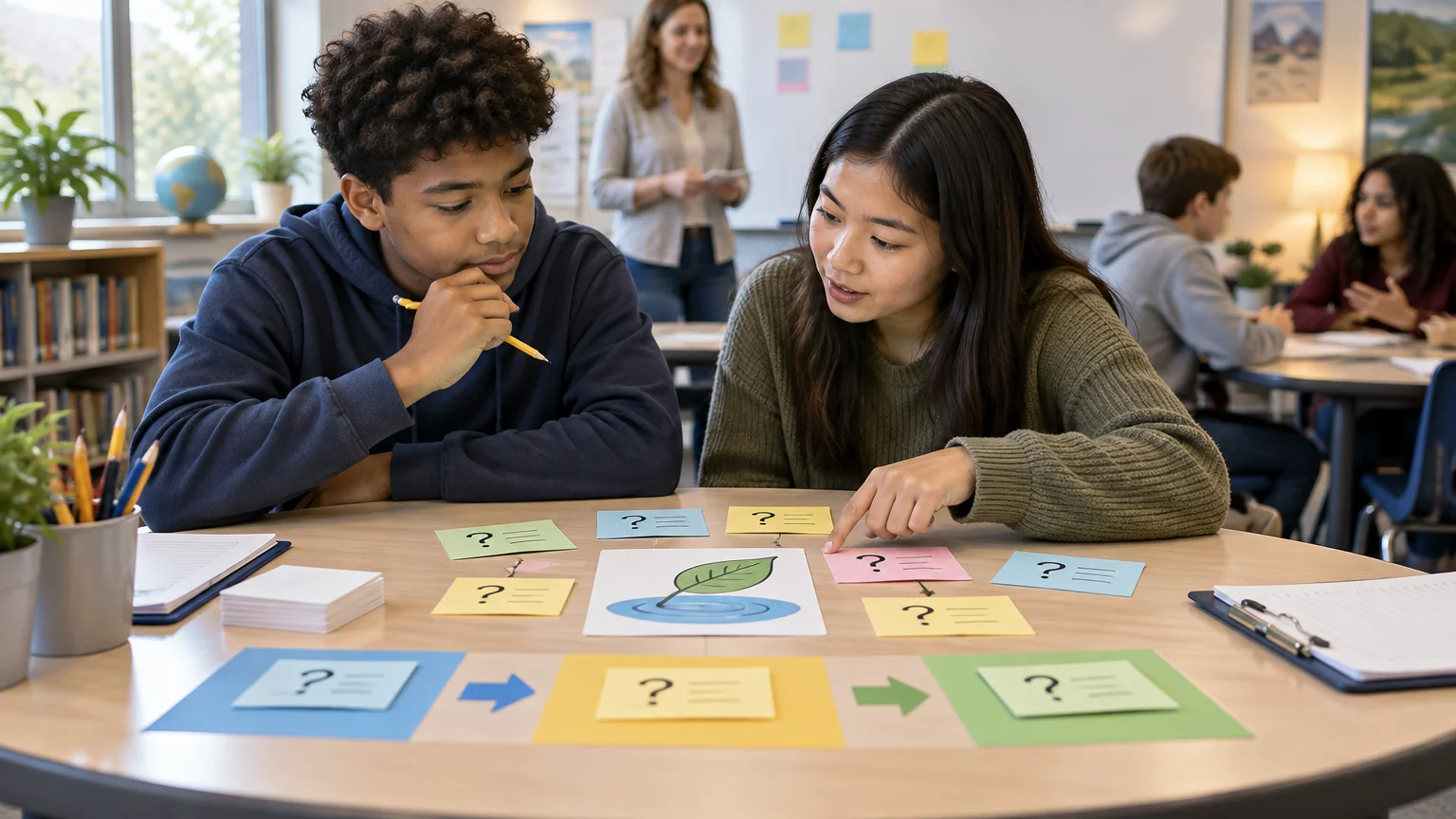
TLDR: A student question generation activity works best when students have a specific focus, quiet thinking time, simple rules, optional question stems, and a real reason to use their questions. In 20 to 30 minutes, a class can generate questions, improve selected questions, choose the ones that fit the lesson goal, and decide what to do with them next.
The aim is not to produce the greatest possible number of clever questions. It is to make questioning a learnable routine. Students should leave knowing how to notice uncertainty, express curiosity, and select a question that can guide reading, investigation, discussion, problem-solving, or peer teaching.
What is a student question generation activity?
It is a structured routine in which students create questions about a shared focus and then improve, prioritize, and use those questions. The focus might be a photograph, graph, quotation, demonstration, worked example, historical object, short text, design problem, or puzzling claim.
Structure matters because “Write three questions” is not equally accessible to every learner. A review of generative-learning strategies found that results vary by age and implementation. Younger students may particularly need explicit instruction, sufficient time, modeling, and scaffolds such as question stems. The same review reported mixed findings for upper-elementary through secondary learners rather than a guaranteed benefit from unguided question generation. The review of generative learning across age groups provides useful context for choosing that support.
Student-generated questions also give a teacher useful formative information. Recall-only questions may suggest that students are concentrating on names, definitions, or isolated facts. Questions about causes, anomalies, applications, or evidence can reveal different interests and uncertainties. This is information for planning, however, not proof that a student has mastered the material.
A 20–30 minute Question → Improve → Use routine
This routine draws on a straightforward principle found in the Right Question Institute’s Question Formulation Technique: let learners produce questions before answering or judging them, then examine question types, prioritize, plan next steps, and reflect. Its facilitation guide estimates about 30 to 40 minutes for a full group process, while a shortened individual version may take 15 minutes or less. See the Question Formulation Technique facilitation guide for the fuller protocol.
| Stage | Time | What students do | Teacher move |
|---|---|---|---|
| 1. Meet the focus | 2 minutes | Observe or read the shared Question Focus without discussing answers. | Present one clear, engaging prompt and explain the lesson purpose. |
| 2. Think privately | 1–2 minutes | Record words, uncertainties, or possible questions. | Allow writing, drawing, typing, or oral rehearsal. |
| 3. Generate | 4–6 minutes | List questions without stopping to answer, debate, or rank them. | Circulate, prompt participation, and postpone evaluation. |
| 4. Improve | 4–5 minutes | Clarify vague wording and revise one or two questions. | Model a revision without taking over the thinking. |
| 5. Prioritize | 3–4 minutes | Choose questions that fit stated criteria. | Keep the criterion visible and require a brief reason. |
| 6. Use | 5–10 minutes or later | Investigate, discuss, sort, research, or answer selected questions. | Give the questions a genuine role in the lesson. |
| 7. Reflect | 2 minutes | Name what helped them create or improve a useful question. | Collect a quick written or spoken reflection. |
Choose a focused Question Focus
A good Question Focus is specific enough to direct attention but incomplete enough to create uncertainty. Instead of displaying the broad topic “ecosystems,” show an image of a pond after an algae bloom. Instead of “fractions,” show two apparently different solutions to the same comparison problem. Instead of “industrialization,” pair a factory production graph with a worker’s short quotation.
Avoid turning the focus into a teacher question. “Why did the character leave?” asks students to answer your question. The line “She packed before sunrise and left the letter unopened” gives them material from which to generate their own.
State how the questions will be used
Before students prioritize, complete this sentence: “Choose a question that will help us…” The ending should match the lesson. Students might choose a question that helps the class explain a phenomenon, locate evidence across two sources, uncover a misconception, compare methods, plan an investigation, or prepare to teach a partner.
The criterion changes which question is most useful. “When was this built?” may be valuable when constructing a timeline. “Who benefited from its construction?” may be more useful when examining perspective and impact. A question is not strong in the abstract; it is strong for a particular purpose.
Question stems that support better starts
Stems are temporary supports, not formulas students must use forever. Offer a small selection that fits the discipline and gradually remove it as students become more independent.
- Science: What might cause…? What evidence would distinguish…? What would happen if…? How could we test…?
- English language arts: What does this detail suggest…? Why might the author…? How would the meaning change if…? Which evidence supports…?
- Social studies: Whose perspective is missing…? What changed and what remained…? Who benefited…? Which source would help us verify…?
- Mathematics: When does this method work…? Where did these solutions diverge…? Can we represent this another way…? What assumption are we making…?
- World languages: How would I ask for clarification…? Which phrase fits this situation…? How does word choice change the tone…?
- Career and technical education: What constraint matters most…? What could fail…? Which safety check comes first…? How would a client use this…?
For students who freeze when faced with a blank page, begin with noticing language: “I notice…,” “I wonder…,” and “This does not match…” They can turn one observation into a question afterward. This preserves the thinking goal while reducing the demand to formulate a polished question immediately.
Help students improve questions without ranking curiosity
Open and closed questions serve different purposes. Closed questions can confirm a date, definition, calculation, or observable detail. Open questions can support explanation, comparison, prediction, or interpretation. Changing “Did the temperature rise?” to “How did temperature change, and what could explain the pattern?” broadens the investigation, but open wording is not automatic evidence of deeper thinking.
Ask students to improve one question with a targeted move rather than labeling the original “weak.” Useful revision moves include making the subject precise, replacing an unclear pronoun, adding a time period, naming the evidence needed, or connecting the question to the lesson goal.
Research from a Grade 8 science setting distinguished factual and procedural questions from generative questions involving comprehension, prediction, anomaly detection, application, and planning. In that context, problem-solving tasks prompted more generative questions than teacher-directed activity. The study of student-generated questions in science supports giving students a meaningful problem rather than expecting wording tricks alone to create depth.
Adapt the routine by age and experience
| Learners | Recommended adaptation | Practical starting point |
|---|---|---|
| K–2 | Use a concrete object, image, or brief demonstration. Accept oral questions and teacher dictation. | Generate questions as a class, then choose one to investigate together. |
| Grades 3–5 | Model question formation, provide three or four stems, and alternate private thinking with partner talk. | Ask pairs to revise one question for clarity before sharing. |
| Grades 6–12 | Tie selection criteria to disciplinary work and require students to explain their choice. | Have groups prioritize one question for evidence gathering and one for discussion. |
| Postsecondary and adult | Use incomplete cases, competing explanations, data, or authentic workplace problems. | Ask learners to identify what information is missing and which question should be answered first. |
Independence should be built gradually. A younger class may need the teacher to record every question and model a single revision. Experienced learners may be ready to generate individually, compare in groups, and defend their priorities. Group work is not automatically better: private thinking before collaboration helps prevent the quickest speaker from defining the group’s entire list.
Make participation accessible without reducing the thinking
Question generation combines several demands: observing, retrieving language, composing a sentence, writing or typing it, monitoring social risk, and responding within a time limit. A student can have a worthwhile question while finding one of those other demands difficult.
Offer different ways to compose and share: oral rehearsal, drawing followed by dictation, typing, speech-to-text, partner work, movable word cards, or a shared scribe. CAST’s Universal Design for Learning guidance emphasizes learner agency, multiple media for communication, varied response methods, accessible tools, collaboration, and graduated support. Explore the CAST UDL Guidelines for the broader accessibility framework.
Keep the intended thinking consistent. If the goal is to identify missing evidence, speech-to-text changes the response method without changing that goal. If precise written question formation is itself the language objective, oral rehearsal can support students before they produce the written version.
Fix common problems quickly
- Students produce only factual questions: Add a problem, contradiction, unexplained result, or competing claim. Then offer stems for causes, evidence, patterns, and consequences.
- Questions drift off topic: Restate the purpose and ask, “How would answering this help us with today’s task?” Save interesting tangents in a parking-lot list.
- One student dominates: Require one minute of private generation before pairs or groups combine their questions. Use a round in which each person contributes before anyone contributes twice.
- Students cannot get started: Let them list observations first, rehearse with a partner, or choose from a few stems. Model turning one observation into a question.
- Wording is confusing: Ask the student what they want to find out, repeat that meaning back, and let the student revise the wording.
- There is not enough time to answer everything: Do not promise that every question will be answered. Sort questions into “use today,” “save for later,” and “investigate independently.”
- Students expect the teacher to judge every question: Ask groups to apply a visible criterion and explain their priorities. The teacher can check relevance without becoming the sole owner of quality.
Question generation is not the same as making a quiz
Student-created quiz questions usually check whether someone can recall or apply material that has already been taught. Broad question generation can happen before, during, or after instruction and may expose uncertainty that has no immediate answer. Both have value, but they serve different purposes.
If the goal is review, selected student questions can become prompts for classroom review cards and games. Before using them, verify the answer, remove accidental ambiguity, and decide whether the card is testing recall, explanation, comparison, or application. If the goal is inquiry, preserve unanswered questions for investigation instead of forcing them into quiz format.
A concrete next step
For your next lesson, choose one shared focus and one use for the resulting questions. Give students one minute to think privately, five minutes to generate, and three minutes to select a question using a visible criterion. Then use at least one selected question in the lesson.
Finish by asking, “What helped you create or improve a useful question?” That reflection turns an engaging activity into a repeatable learning routine. Over time, reduce the stems and teacher modeling as students become more able to generate, evaluate, and act on questions independently.
References
- Generative Learning: Which Strategies for What Age? | Educational Psychology Review | Springer Nature Link
- rightquestion.org
- Student-generated questions: A meaningful aspect of learning in science: International Journal of Science Education: Vol 24, No 5
- CAST Universal Design for Learning Guidelines